Science Worksheets
Printable science worksheets that cover the big topics of elementary science: plants and animals, habitats and food chains, the water cycle and weather, rocks and soil, states of matter, forces and magnets — each with clear diagrams to label, short questions and an answer key.
Elementary Science Worksheets
Life, earth and physical science worksheets — plants, animals, food chains, water cycle, weather, rocks, matter and magnets — with answer keys.
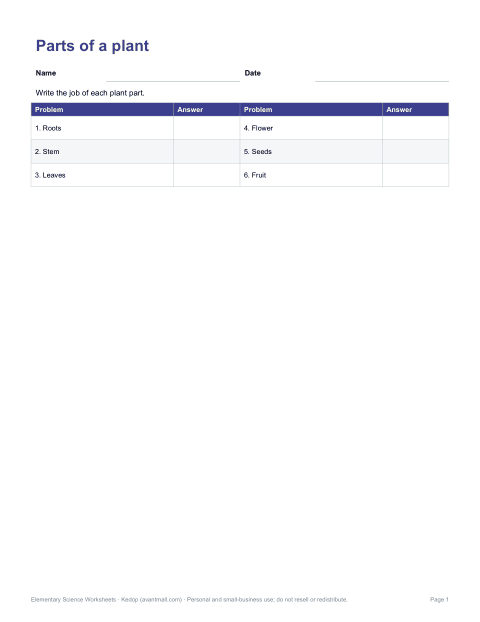
- Parts of a plant (PDF, DOCX)
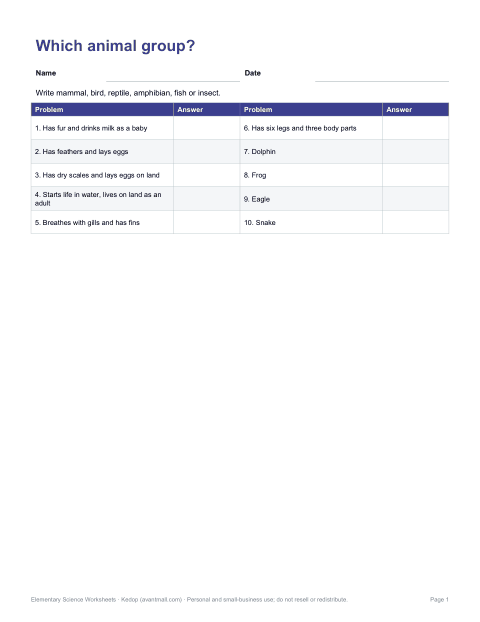
- Animal groups (PDF, DOCX)
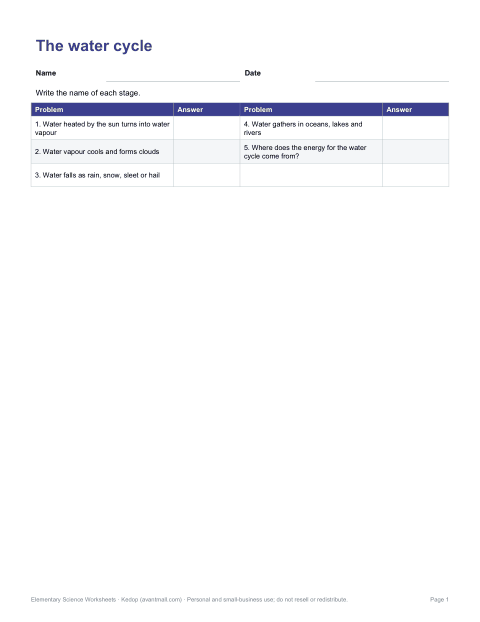
- Water cycle (PDF, DOCX)
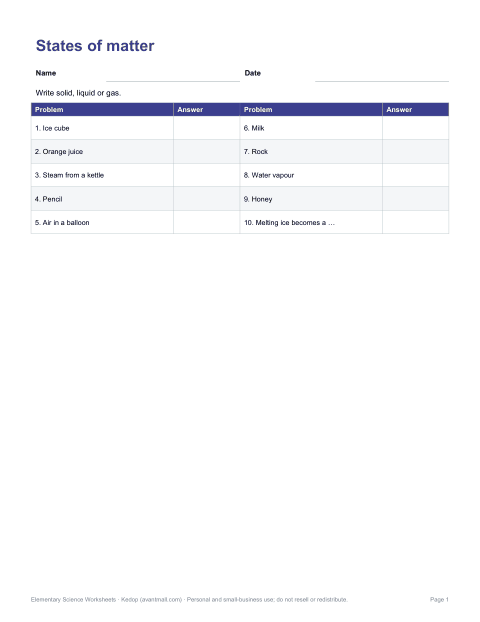
- States of matter (PDF, DOCX)
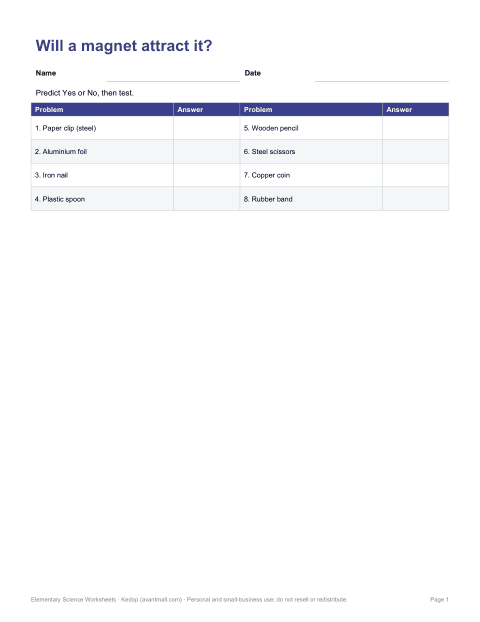
- Magnets (PDF, DOCX)
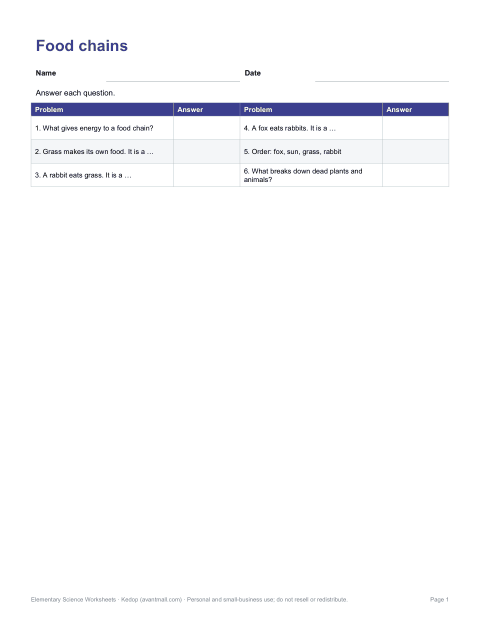
- Food chains (PDF, DOCX)
Formats: PDF, DOCX. Instant download after payment (link valid 72 hours, up to 5 downloads). AI-assisted: the templates were drafted with AI help and reviewed and laid out by Kedop.
$7.00 USD, one-time
Secure card checkout by Stripe. Full refund within 7 days — see the refund policy and license.
Topics in the science worksheet pack
| Area | Worksheets | Key ideas |
|---|---|---|
| Life science | Parts of a plant; what plants need; animal groups; life cycle of a butterfly; food chains | Living things have structures that help them survive; energy flows from the sun through food chains |
| Earth science | Water cycle; weather tools; types of rocks; layers of soil | Water moves in a cycle; weather can be measured; rocks form in different ways |
| Physical science | States of matter; push and pull; magnets; light and shadows | Matter can be solid, liquid or gas; forces change motion; magnets attract some metals |
| Science skills | Scientific method; making observations; reading a bar graph | Scientists ask questions, test ideas and record data |
What makes these worksheets useful
Each worksheet focuses on one idea with a short explanation, a labelling or sorting task, and three to five questions that move from recall to explanation. Answer keys give model answers. Diagrams are simple line drawings that photocopy clearly and can be coloured. The pages work as follow-up after a hands-on lesson — the best science learning starts with real observation and experiments, and worksheets help students organise and remember what they found.
Sample activities
- Parts of a plant — label roots, stem, leaves, flower and seeds, and match each part to its job.
- Animal groups — sort animals into mammals, birds, reptiles, amphibians, fish and insects using clues such as fur, feathers, scales and number of legs.
- Water cycle — label evaporation, condensation, precipitation and collection, then explain where rain comes from.
- States of matter — sort everyday items into solids, liquids and gases and describe how water changes state.
- Magnets — predict and test which objects a magnet attracts, and record results in a table.
- Food chain — arrange sun, grass, rabbit and fox and label producers and consumers.
Hands-on ideas to pair with the worksheets
- Grow bean seeds in clear cups to watch roots and shoots.
- Make a mini water cycle in a sealed plastic bag taped to a sunny window.
- Freeze and melt water and measure temperatures.
- Test objects around the classroom with a magnet.
- Keep a weather chart for two weeks with a thermometer and rain gauge.
- Go on a schoolyard habitat walk and record living and non-living things.
Who it is for
Teachers of grades 2–5, homeschooling families and tutors. Topics follow common elementary science curricula, including themes found in the Next Generation Science Standards for these grades, such as plant and animal structures, weather and climate, and properties of matter. Adapt vocabulary to your class using the editable Word files.
Formats
Every worksheet and key is a print-ready PDF (US Letter; prints on A4) and an editable DOCX file. Pages are designed for black-and-white printing.
Assessing understanding
Worksheets show what students can recall, but asking them to explain their thinking reveals understanding. Each sheet ends with at least one “why” or “how” question — why does a plant need leaves, how does water get back into the clouds — that can be answered in a sentence or a labelled drawing. Use these as quick formative checks: sort responses into “got it”, “partly” and “not yet”, and plan the next hands-on activity for the “not yet” group. The answer keys include model explanations as well as short answers.
Frequently asked questions
What grades are these science worksheets for?
Mainly grades 2–5.
Are answer keys included?
Yes, every worksheet has a key with model answers.
Do they align with standards?
They cover topics common to elementary science curricula, including NGSS themes, but are not officially endorsed.
Can I edit them?
Yes, the Word versions are editable.
Was AI used to create them?
The worksheets were drafted with AI assistance and then checked, edited and formatted by Kedop.
How long does each worksheet take?
Most take 15–20 minutes, including discussion, which makes them suitable for a science block or homework.